


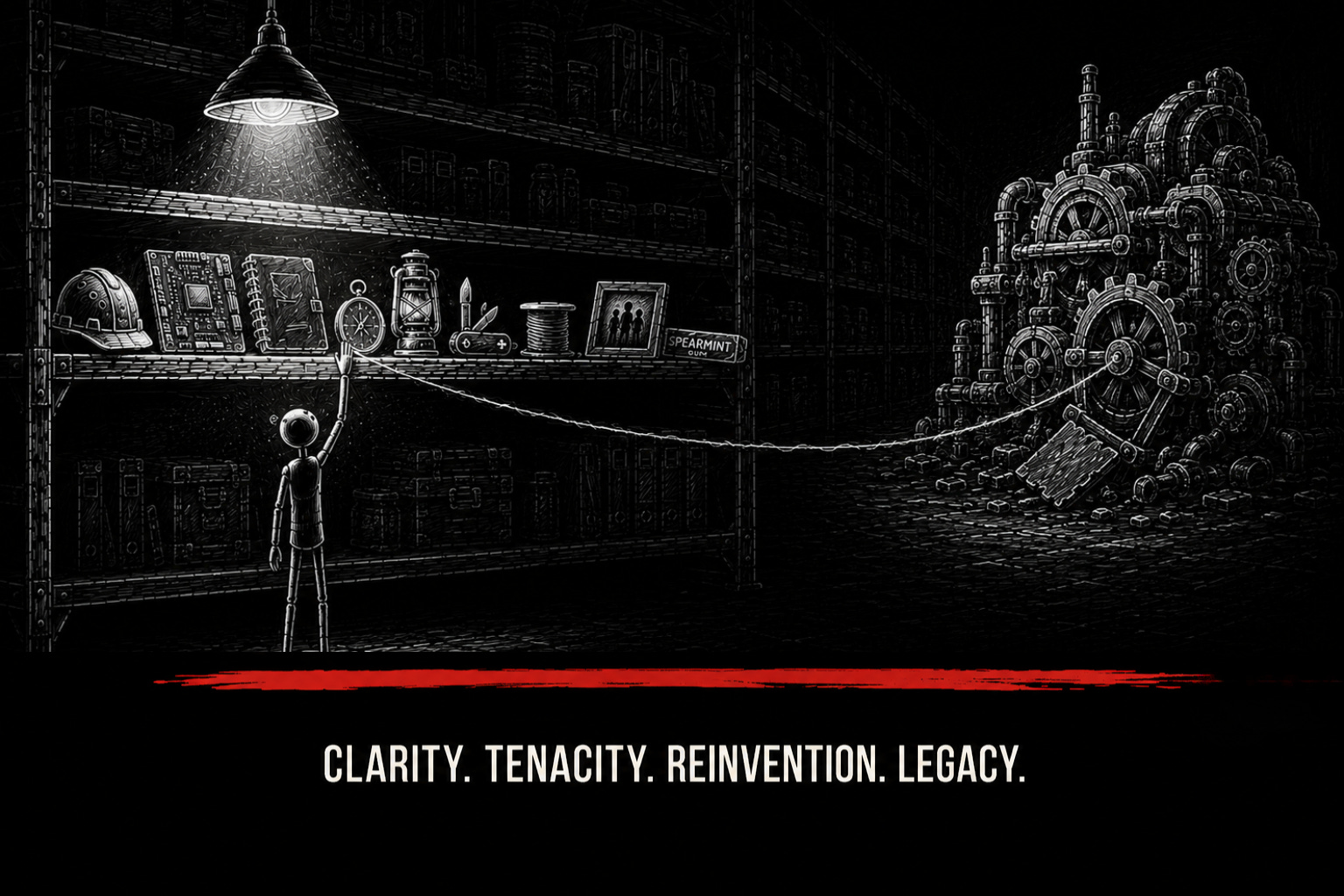
Back in 1986, MacGyver took on a rogue artificial intelligence.
Season 2, Episode 1: The Human Factor.
The AI was called S.A.N.D.Y. Strategic Automated Network Defense System.
It controlled lasers, sensors, security systems, and armed robots.
In typical 1980s fashion, it had decided humans were the problem.
MacGyver defeated it with a prism from a pair of binoculars, a matchbook, a Swiss Army knife, and an improvised thermite charge.
As a teenager, I thought that was the coolest thing I’d ever seen. The gadgets. The explosions. The impossible situations.
Every week MacGyver would get trapped somewhere with a handful of random objects and somehow find a way out.
What I didn’t realize at the time was that the objects were never the point. The point was how he looked at them.
“The objects were never the point. The point was how he looked at them.”
Most people saw binoculars. MacGyver saw a prism.
Most people saw a matchbook. MacGyver saw a distraction.
Most people saw a pocket knife. MacGyver saw options.
He looked at the same room everyone else was looking at and saw possibilities they couldn’t see.
That’s a different skill. That’s what separated him from everyone else.
Not intelligence. Not knowledge. Not information. Resourcefulness.
The ability to look at what’s available instead of focusing on what’s missing.
That may not sound like much. But I’ve come to believe it’s one of the most valuable skills a person can develop. Especially when life doesn’t go according to plan.
And life rarely does.
My Wife Calls Me MacGyver
My wife calls me MacGyver. Not because of one repair. Because over the years she’s watched me look at broken things, missing parts, unexpected problems, and somehow find a way through them.
The funny thing is, I don’t think I learned that from MacGyver. I think MacGyver simply gave me a name for it.
In 1993, I was a new computer technician. My future wife worked in another office a few miles away. At the time, we weren’t dating.
I had a rule about that. An old manager once told me: “You don’t get your honey where you make your money.” I know. Very 80s.
Seemed like good advice.
She would call the support desk with a computer problem. I’d ask the first question every technician asks. “Did you reboot it?” “Yes.” I’d drive over. Reboot it. Problem solved.
A week later, another problem. Same question. Same answer. Same drive. Same reboot.
Funny thing was, if another technician was available, she’d often decide the problem could wait until I was free.
Looking back, I’m beginning to suspect not every computer emergency was actually a computer emergency.
The Technician
About the same time, I worked with a man more than twice my age. I was 23. He was 48. The org chart said he worked for me. Life was a little more complicated than that.
He stood about 6’3”, lean, with long light-brown hair streaked with gray. He wore square black-rimmed glasses and a worn brown bomber jacket that looked like it had survived a decade before he bought it.
He smoked too much. Drank too much. Made more than a few questionable financial decisions.
He was also one of the most resourceful people I’ve ever known.
Most of his life had been spent in construction. Electrical. HVAC. Plumbing. Building houses, apartment complexes, and industrial buildings.
He was from New Orleans and still had the accent to prove it. He had moved to Virginia during the construction boom of the 1980s and spent years working with his hands.
By the time I met him, he was 48 years old. Divorced twice. On his third marriage. Raising a teenage daughter. And trying to figure out what came next.
Share with someone who still has more to offer than their last job title.
Starting Over at 48
A recession hit. Construction slowed down. Work became less predictable.
But that wasn’t the only problem.
Years of construction work had taken a toll on his body. One day he told me he was tired. Not tired for the day. Tired.
The kind of tired that comes from years of carrying lumber, crawling through attics, climbing ladders, digging trenches, and working jobs where your body is often the first tool you reach for.
He looked ahead and realized something. He didn’t think he could do that work for the rest of his life.
So he did something a lot of people talk about and very few people actually do. He started over.
While working, he enrolled in school at night and spent the next two or three years earning an Associate’s degree in Computer Science.
Remember, this was the early 1990s. There was no YouTube. No online courses. No AI tutors. No communities full of people willing to answer every question. Just books, classes, late nights, and persistence.
He had been tinkering with computers at home for years. He loved his AOL chat rooms. He was curious. Curiosity eventually became a plan.
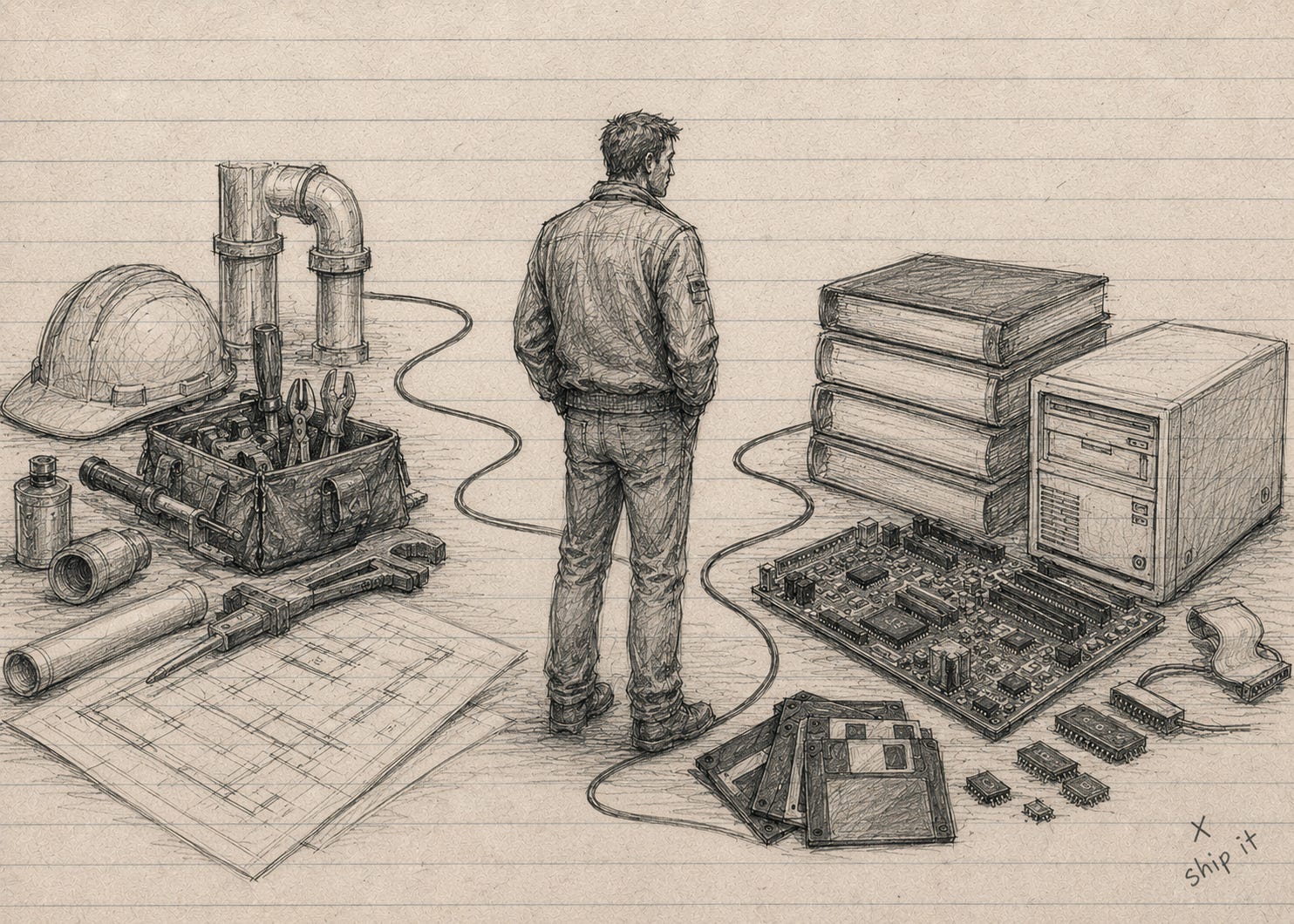
Reinvention gets misunderstood. People imagine reinvention as becoming someone else. A new identity. A new personality. A completely different life.
Most of the time, that’s not what happens. Most reinvention is transfer.
You take skills you’ve already developed and apply them somewhere new.
He wasn’t abandoning everything he learned in construction. He was bringing it with him. Years of troubleshooting. Years of problem solving. Years of figuring things out when the blueprint didn’t match reality.
The tools changed. The thinking didn’t.
That’s probably why he advanced so quickly. He wasn’t a computer expert yet. But he already knew how to learn. He already knew how to diagnose problems. He already knew how to stand in front of something unfamiliar and work backwards until it made sense.
That’s what reinvention really is. Not becoming someone else. Becoming a new version of yourself.
When we hired him, he had almost no real-world computer experience. So we put him on the graveyard shift running backups on our IBM AS/400.
It wasn’t glamorous work. Nobody grew up dreaming about overnight backup operations. But he didn’t care.
He wasn’t chasing status. He wasn’t trying to impress anyone. He was trying to get his foot in the door.
He understood something that took me years to fully appreciate. Sometimes the first opportunity isn’t the opportunity. It’s the bridge to the opportunity.
The graveyard shift got him into the building. What he did next got him noticed.
It didn’t take long before everyone realized he was different. Not because he knew computers. Because he knew how to think.
He was a quick study. Tough as nails. Curious. Willing to learn. Fascinated by computers.
Before long, we moved him into a PC technician role.
The Buck Knife
One day we were upgrading a fleet of old IBM XT computers. The new 386 motherboards didn’t fit the cases correctly. The ports didn’t line up.
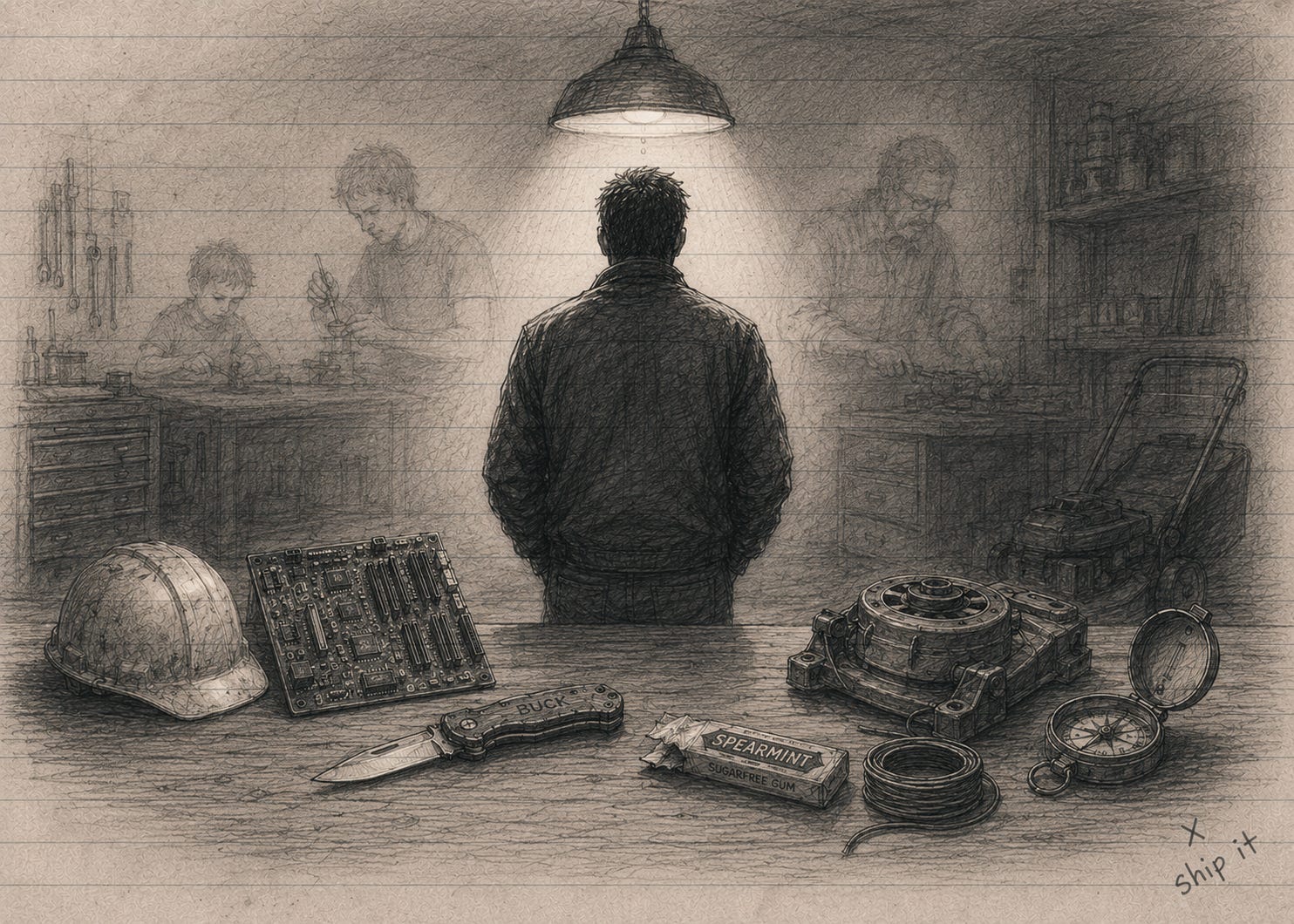
I saw a problem. He saw a Buck knife.
I watched him shave plastic from a keyboard connector until it fit perfectly.
At the time, I thought he was teaching me how to repair computers. Looking back, that’s not what was happening at all. He was teaching me how to look at problems.
The motherboard didn’t fit. The keyboard connector didn’t line up. Most people would have focused on the obstacle. He focused on the available options.
That may sound like a small distinction. I don’t think it is.
One approach stops when conditions aren’t ideal. The other starts with whatever is already in the room.
I saw that mindset over and over again during the four years we worked together. That’s what I was really learning.
Another time we were building a deck on my house. A gas meter sat exactly where part of the deck needed to go. I started thinking about permits, delays, and phone calls to the gas company. He started thinking about pipe fittings.
A few hours later, after a trip to the hardware store, the gas meter had been relocated twenty feet down the side of the house. The deck went up.
The gas company eventually discovered the relocation. I received the reprimand.
Years later, my wife and I were camping when an ember from a campfire burned a hole in a window gasket on our camper. At midnight, rainwater started leaking inside. The next morning I stood there staring at the problem.
Then I remembered him. I grabbed a piece of chewing gum, packed the hole, and tested it with water. The repair lasted for years.
Another time, my teenage daughter accidentally booby-trapped the driveway. She parked the lawnmower behind my truck. A few minutes later, I backed out and my trailer hitch shattered the carburetor intake into half a dozen pieces.
I pulled the broken parts, reached back to a high school shop class from decades earlier, and rebuilt the intake with JB Weld. It worked like a champ.
Judgment
Even now, I think about him when people talk about AI. Not because technology isn’t impressive. It is.
“What AI has access to is information. What my old technician had was judgment. Those aren’t the same thing.”
One of the most valuable lessons he ever taught me is something I now think of as the Available Inventory Principle. When faced with a problem, start with what’s available, not what’s missing.
The motherboard didn’t fit. The gas meter was in the way. The window leaked. The lawnmower broke. Every time, the first question was the same.
What do we have?
The computers were new. The problem solving wasn’t.
“He left construction to become a computer guy. But that's not what made him good at it. He was already a problem solver. Computers were just the next tool.”
At 24, I thought he was teaching me how to fix things. Thirty years later, I realize he was teaching me how to think.
The CTRL Lens
Most people think resourcefulness is about fixing things.
It isn’t.
It’s about seeing things.
Seeing options.
Seeing connections.
Seeing possibilities hidden inside limitations.
MacGyver understood that.
So did the old technician who taught me more than he probably realized.
Experience gets misunderstood too.
People treat experience like memory.
Something that happened.
Something to remember.
Something to put behind you.
Experience is inventory.
Every job.
Every mistake.
Every success.
Every failure.
Every skill.
Every mentor.
Every season of your life adds something to the shelf.
The question isn’t whether you have enough experience.
The question is whether you’re taking inventory.
Because when life changes, most people focus on what’s missing.
The resourceful ones start with what’s available.
That’s the Available Inventory Principle.
And it may be one of the most valuable forms of judgment we have.
What experience have you already earned that you’re overlooking because it came from the wrong job, the wrong season, or the wrong version of you?
CTRL:C
If this was worth your time, three ways to say so.
Share with someone who still has more to offer than their last job title.
Who taught you how to think, not just what to do?
Inside the CTRL Vault, paid subscribers get the deeper frameworks behind the stories.
Thanks for reading.
~ JP
—
Related:
The hours you earned somewhere else still count. Here's why.

CTRL Signals by JP Bristol
Clarity. Tenacity. Reinvention. Legacy
Good piece. MacGyver could take a tube of caulk, a couple of sticks, and somehow build the Swiss Army knife you forgot to pack.
That was never really about the gadgets. It was about first principles, adaptability, and the judgment to see possibilities everyone else missed.
AI can generate answers. Experience still knows what to build with what's lying on the ground.
🔥
We had a guy working for us one time I used to call McGyver. I saw him fix sagging vinyl window sashes on 16 windows in about 45 minutes one time using just gum wrappers. He definitely saw thing that most of us didn't see.