


This week in the Vault:
Free subscribers get the pattern named. Why growth decisions start feeling emotionally dangerous once you build a stable life. The hidden shift from possibility to exposure.
Paid subscribers get the deeper diagnostic. The emotional math behind hesitation. Why smart people quietly stop betting on themselves in midlife. And the move that creates momentum without requiring you to blow up your entire life.
If you have ever called yourself “responsible” while quietly delaying work that mattered to you, this one is for you.
New to the Vault? Start here.
How responsibility quietly becomes hesitation. How visible failure starts feeling dangerous. And the move that creates momentum without blowing up what you’ve built.
The Certainty Trap
For years I thought I was being financially responsible.
Then I realized something uncomfortable.
I treated growth decisions completely differently than almost every other purchase in my life.
Trips.
Dinners.
Technology.
Those decisions still carried stress.
But growth felt different.
Anything tied to leadership, communication, reinvention, or becoming something more triggered a completely different kind of hesitation.
I wanted certainty.
Proof.
Perfect timing.
Which is a fantastic way to never start anything.
And the older I got, the more convincing the internal argument sounded.
Not irresponsible.
Responsible.
But sometimes fear starts sounding a lot like responsibility.
When Growth Starts Feeling Dangerous
The strange part is I did not see this in my twenties.
Back then growth still felt connected to possibility.
Somewhere along the way it started feeling connected to risk.
Especially once you build a functional life.
A career.
Responsibilities.
A reputation.
People depending on you.
At that point growth stops feeling inspirational and starts feeling exposing.
Because now failure has witnesses.
That changes people.
You start overthinking things you would have jumped into ten years earlier.
You start needing complete plans before movement.
My brain loved this strategy. Very safe. Very productive-looking.
You start confusing caution with wisdom.
I know because I did exactly that.
The Room Changed First
A few years after moving into sales, I attended a manufacturer training session with one of the best product demonstrations I had ever seen.
The room itself changed the experience.
It felt real.
I came back obsessed with the idea.
At our office we had an unused room in the building, and I decided I wanted to transform it into a mocked-up fine dining restaurant for customer demos.
Artwork.
Floor lamps.
Burgundy walls.
Real atmosphere.
Not another sterile technology presentation.
So I started doing what I always did.
Planning.
Sketching.
Thinking.
Trying to see the entire path before taking the first step.
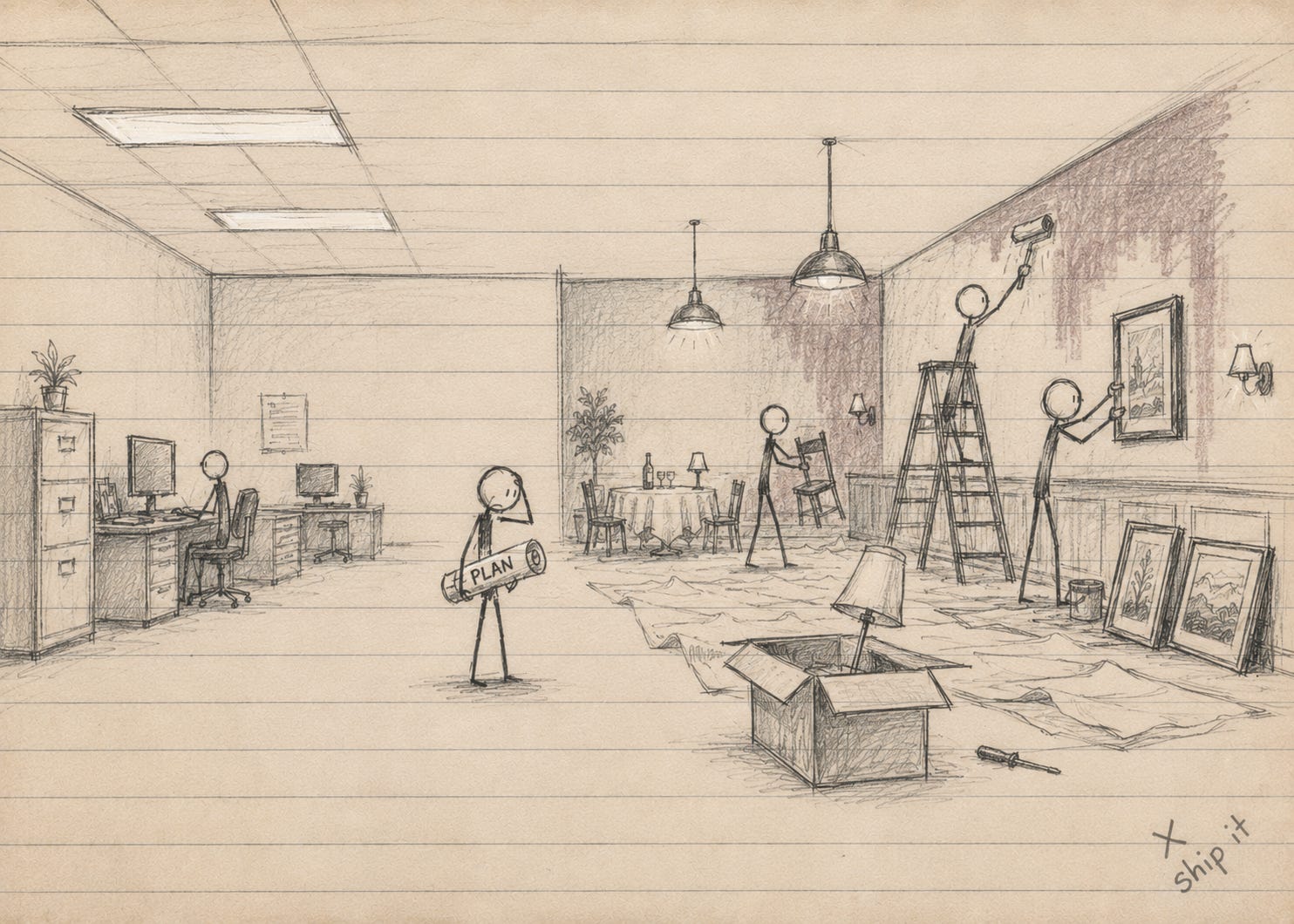
Then I pitched the idea to a senior VP about twenty-five years older than me.
I expected meetings.
Instead, we walked straight back to the room and started tearing it apart.
Desks moved.
Equipment disappeared.
Paint showed up.
Employees jumped in.
The room started transforming before the plan was fully formed.
Honestly, I was uncomfortable the entire time.
That was not my natural wiring.
I liked certainty.
I liked complete plans.
I liked knowing where things were headed before movement started.
But standing in the middle of that room while everything changed in real time, I realized something I still carry with me today:
The people I thought had everything figured out were often just willing to move before they felt ready.
Confident people were not operating from certainty.
They were operating from decision.
Then I spent enough years around executives, salespeople, leaders, and operators to realize most of them were winging it, like everyone.
Some people just hide the uncertainty better than others.
I know what you’re thinking.
“That’s easy to say now.”
Fair.
Most lessons sound cleaner in reverse.
In real time it never felt clean.
It felt risky.
Messy.
Exposing.
Especially once you build a life people depend on.
At twenty-five, failure feels embarrassing.
At fifty-four, it feels irresponsible.
That changes the emotional math completely.
Share this with someone who keeps calculating instead of moving.