



My grandfather retired at 70.
He was a workaholic by nature.
Long days.
Rarely took time off.
The annual vacation happened because my grandmother insisted on it.
He spent decades building a career, raising a family, doing the responsible thing.
At 70 he finally stepped back.
He had five good years.
At 75 a hip replacement forced him to relearn how to walk.
Then came the diagnosis.
A rare blood cancer.
The last three years of his life meant blood transfusions three times a week.
And in the final year, he lost his ability to read.
My grandfather had a library with thousands of books.
He had been reading since his early days in college.
In the last year of his life, he could not comprehend the words.
He thought he had time. He did not know he was already spending it.
The Math Nobody Does
Most mid-career professionals know they are waiting too long.
They feel it.
The restlessness that does not go away after a vacation.
The Sunday dread that has been there so long it feels normal.
The gap between the work they are doing and the work they know they are capable of.
They know the cost is real.
What they have not done is calculate it.
Because calculating it means confronting it.
And confronting it means deciding.
Most people would rather stay in the fog than do the math that kills the excuse.
I did.
My grandfather stayed in the fog for decades.
He called it responsibility.
He called it providing.
He called it doing the right thing.
And he was not wrong.
But the math was running the whole time.
Whether he looked at it or not.
The Numbers I Did Not Want to Face
I read a book called 20,000 Days and Counting.
The premise is simple and brutal.
You have roughly 20,000 days of adult life.
Count back from today.
Count forward to a reasonable expectation.
Do the math.
I did the math.
Then I sat down with my wife and we talked about it.
Here is what the math actually says for someone who is 54, turning 55 this year.
Life expectancy for men born in 1971: roughly 77 years.
Years remaining: 22.
That sounds like a long time.
It’s not.
What 22 Years Actually Means
Twenty-two years sounds generous until you start subtracting.
Subtract the years at the end where health and capacity narrow.
Most people planning honestly account for the last 10 to 12 years of that window being different. Slower. More managed. Less building, more maintaining.
That leaves 10 to 12 high-quality years.
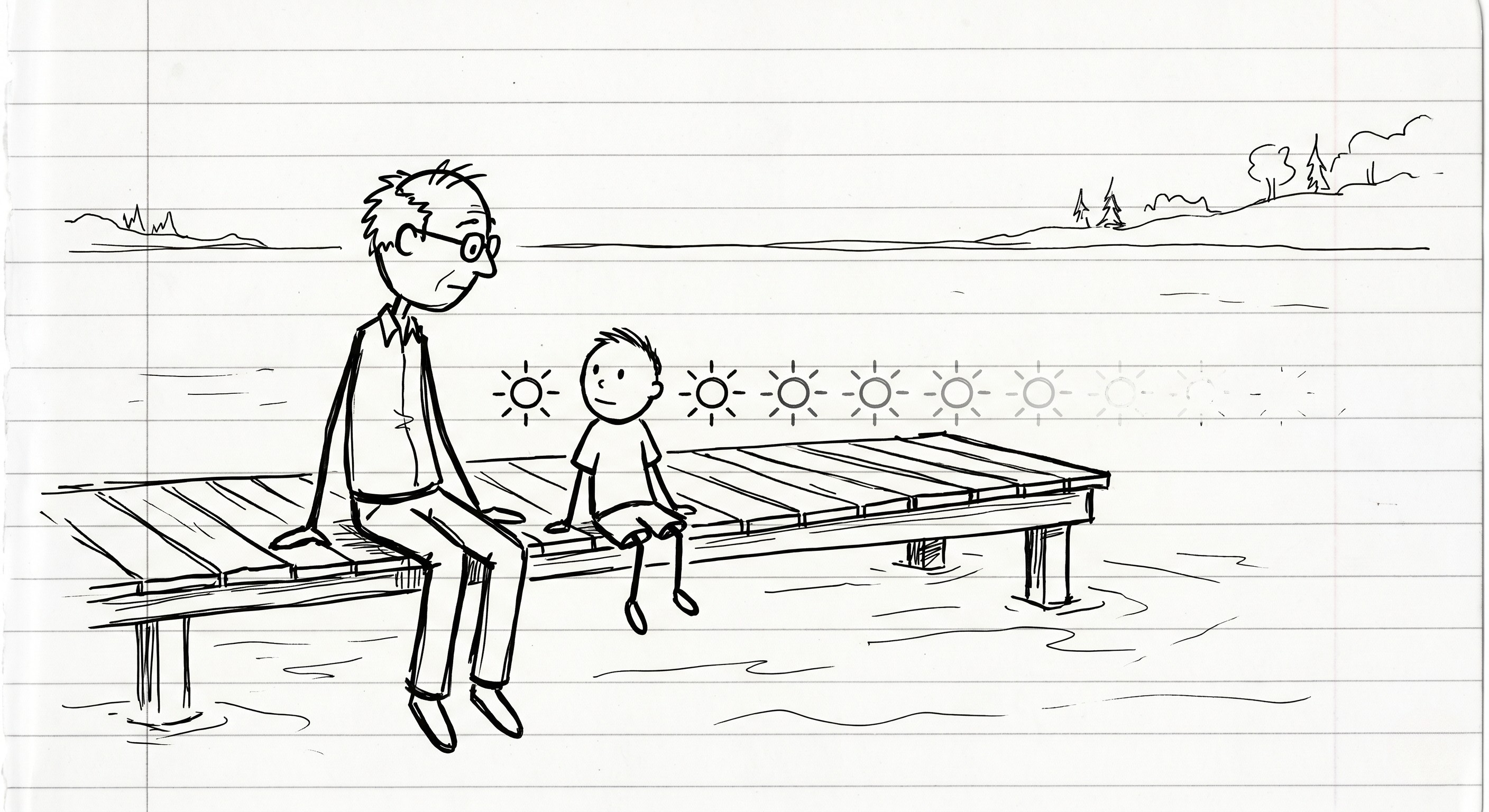
Ten to twelve summers where you are fully yourself.
Healthy.
Mobile.
Free enough to choose what the day looks like.
My grandfather got five.
Now do a different calculation.
Not the career math.
The people math.
The Grandsons
I have two grandsons.
One is 7. One is 12.
When I turn 65, the 12 year old will be 22.
Out of school. Into his own life.
The window to be part of his life, not a guest in it, closes somewhere in the next 5 to 8 summers.
When I turn 65, the 7 year old will be 17.
Still home. Still forming.
But the summers where he chooses to spend time with his grandfather instead of his friends are already numbered.
I am not morbid about this.
I am mathematical about it.
Morbid is dwelling on the ending.
Mathematical is using the ending to make better decisions now.
The window to be the grandfather I want to be is not 22 years.
It is closer to 8.
My grandfather had a library of thousands of books and a grandson who watched him from across the room.