


We Are Excellent at the Wrong Thing
I got good at managing the misery.
Not fixing it.
Managing it.
There is a difference.
I didn’t see it for a long time.
I built a life insurance business on the side. It was supposed to be the exit. Instead it became its own version of the same problem.
I optimized the scripts.
Refined the process.
Put in as many as 30 hours a week on top of my day job.
The balancing act was killing me.
But I kept patching it.
Kept showing up.
Got good at selling something I could no longer see a future in.
The escape plan became the thing I needed to escape from.
That is where most of us live.
Not in crisis.
Not in collapse.
In managed decline we have convinced ourselves is stability.
The Fixer Reflex
We are conditioned to be fixers.
A crack appears and the reflex fires before the thought does.
Sand it.
Fill it.
Paint over it.
Move on.
It is not laziness.
It is not denial.
It is efficiency.
We are Gen X.
We figure things out and we keep moving.
Latchkey summers trained us to solve the immediate problem fast and get back to living.
That wiring saved us then.
It costs us now.
Careers are not drywall.
A crack in a career is not asking to be patched.
It is asking to be read.
What the Crack Is Actually Saying
A crack in drywall means something shifted.
Temperature.
Settling.
Pressure from somewhere in the structure.
The crack is not the problem.
The crack is the report.
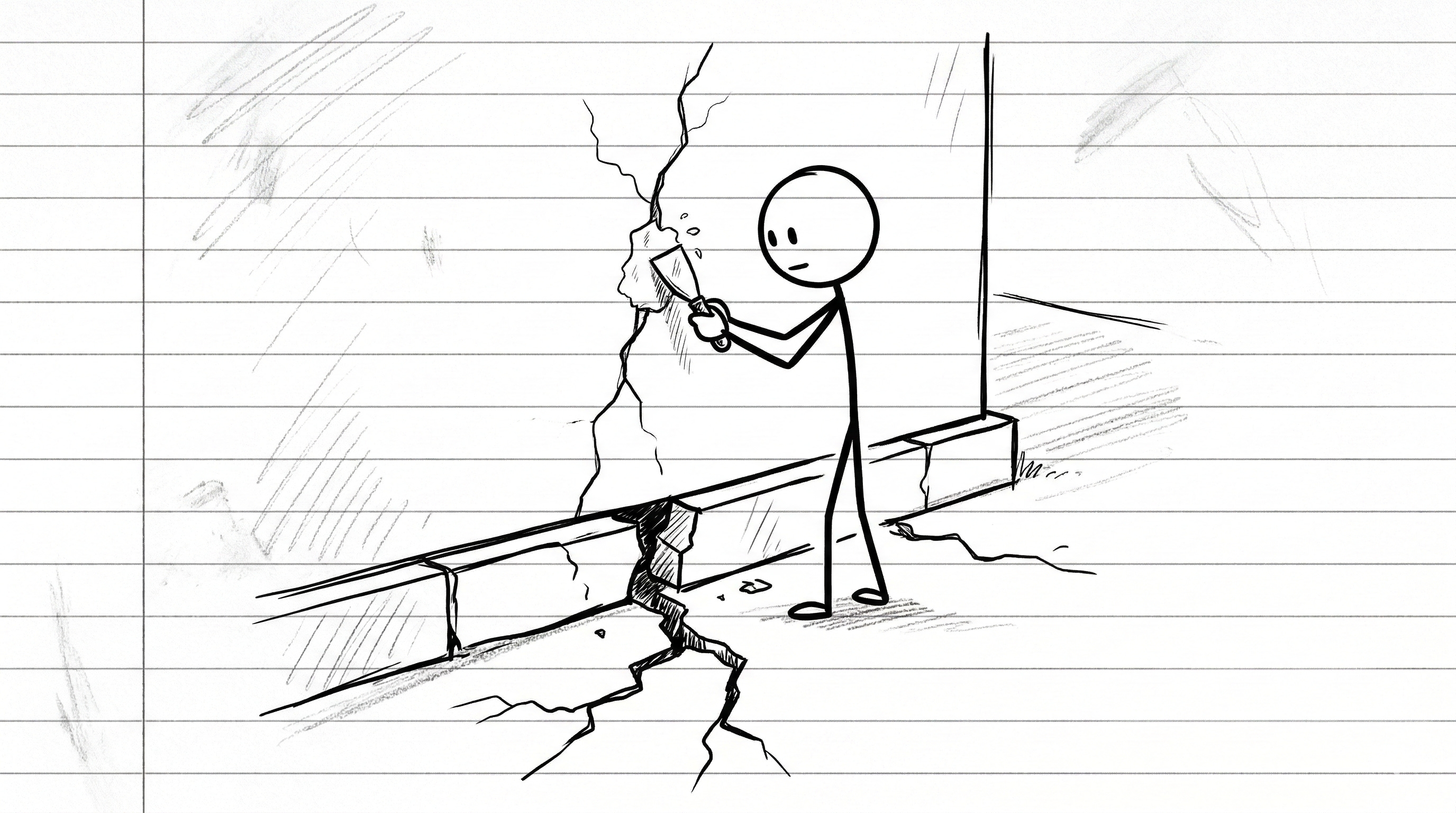
Most of us read the crack and immediately start mixing spackle.
Take the training course to stay relevant in a job we have already mentally left.
Negotiate for a raise in a role that stopped fitting three years ago.
Optimize the schedule, the commute, the coping routine.
Get very good at living inside a problem we have decided not to name.
I did this.
Not for a month.
For over a decade.
I patched that insurance business until my attention was so divided I could not see the path to replacement.
The patches held.
Some of them looked pretty good, actually.
And every time something cracked again, I got faster at the repair.
Excellent patches.
Wrong diagnosis.
The Diagnosis We Avoid
Symptoms are easier to treat than causes.
A headache is easier to medicate than the thing producing the headache.
Burnout is easier to manage with vacation than to address with a decision.
Restlessness is easier to suppress with busyness than to sit with it until it tells you what it wants.
We have entire industries built around symptom management.
Wellness apps.
Productivity systems.
Time-blocking frameworks.
Stress leave.
Some of them help.
None of them answer the real question.
The question is not how do I feel better.
The real question is what is this telling me about the foundation.
The foundation moved for a reason.
Sitting with that means admitting something most of us will do almost anything to avoid.
The crack was not bad luck.
It was information.
And we already know what it said.
The Cost of the Patch
Every patch is a decision to delay the real one.
And the delay is not neutral.
While you are patching, the foundation is still shifting.
The gap between what you are doing and what you should be doing does not stay the same size.
It grows.
So does the cost of addressing it.
I am not saying quit on a Tuesday because you finally read the wall.
I am saying stop calling the patch a solution.
Name it for what it is.
A deferral.
A deliberate choice to fix the visible thing and leave the real thing alone for another season.
That is a legitimate choice sometimes.
Especially when you have obligations.
Especially when you are still holding down a life while trying to build the next one.
But it is only legitimate if you are honest about what you are doing.
Patching is not the same as solving.
A patched life is still a fragile life.
What the Repair Actually Requires
Slowing down long enough to ask a different question.
Not how do I fix this.
But why did this break.
Not what do I need to change.
But what have I been refusing to see.
That question is slower.
More expensive.
It does not produce a fix you can apply over a weekend.
But it is the only question that addresses the actual problem.
I stopped patching the insurance business when I finally admitted the foundation was wrong.
Not the effort.
Not the process.
The premise.
The exit I had built was never going to hold the weight of the life I actually wanted.
Naming that was the first honest thing I did in years.
I do not have all of it figured out.
I am still in it.
But I stopped calling the patch a repair.
That was the first honest thing.
The Foundation Is Asking
You already know where the crack is.
You have known for a while.
You have also gotten very good at the patch.
At the management.
At the routine that makes the misery livable.
That competence is real.
It is not nothing.
But it is also the thing keeping you from asking the harder question.
What if the problem is not the crack.
What if the problem is what you built on.
One question:
What are you patching that is trying to tell you something about the foundation?
CTRL is not about better repairs.
It is about being honest enough to check what is underneath.
—
Thanks for reading.
~ JP
CTRL:C
Related:

Editor’s note: An earlier version described the insurance side business as “30 hours a week.” Clarified to “as many as 30 hours a week” for accuracy.
CTRL Signals by JP Bristol
Clarity. Tenacity. Reinvention. Legacy
This is such a powerful message. What speaks to me the most is when you realize the solution, it was never really about fixing. It was about sitting in the stillness and learning more about the life you want. This is where something new comes alive.
We are all cracked pots but that's what makes us beautiful and unique in our own ways.
Our scars resonate more with others than being "perfect".