


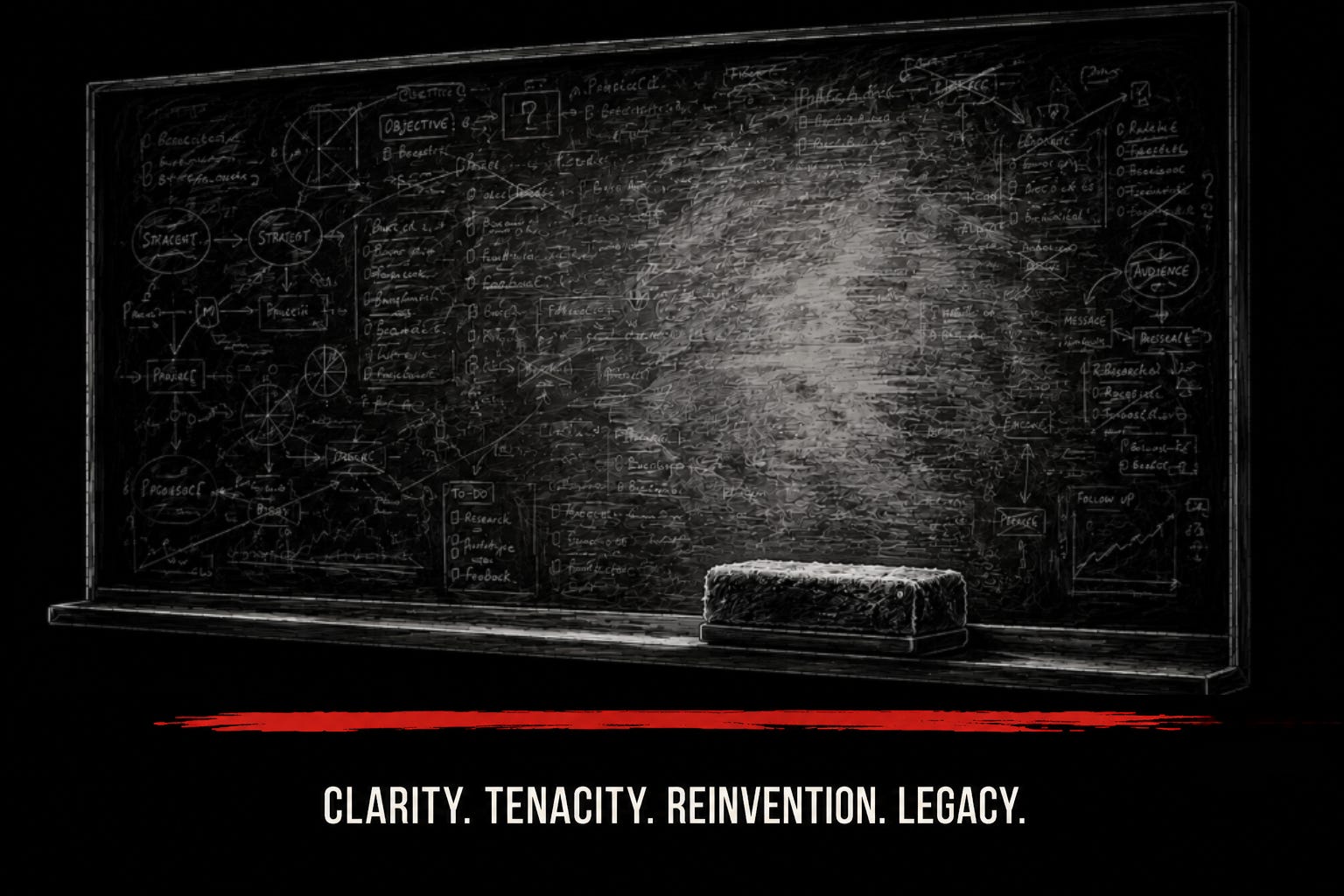
That whiteboard wasn’t documenting ideas.
It was documenting judgment.
I almost erased the most valuable thing on it.
I was standing in front of it the other day, expecting the usual. Boxes. Arrows. Half-finished ideas. Possible essays. Things to research. Questions worth exploring.
Instead, all I could see was empty space.
For a moment, I wondered if I was running out of ideas.
Then I noticed what wasn’t there anymore.
The most valuable thing on the board wasn’t what I’d written.
It was what I’d erased.
Crossed-out ideas.
Dead ends.
Directions I’d decided not to pursue.
Topics that looked interesting for about ten minutes before I realized they weren’t leading anywhere.
Still learning what matters. Still ignoring what doesn't.
The Part Nobody Teaches
I think we misunderstand how experience works.
We assume experience means collecting more. More books. More articles. More opinions. More notes.
But after thirty-seven years in the workforce, that’s not what I’ve seen.
The people whose judgment I trust don’t try to know everything.
They’re remarkably good at deciding what no longer deserves their attention.
That’s a different skill.
And it doesn’t come cheap.
We grew up being told knowledge was power.
Nobody mentioned the other half.
Knowing what to ignore is the part that actually compounds.
Experts don’t know more because they consume more information. They know more because they ignore more information.
I’ve Seen This Movie Before
When you’re younger, almost everything feels worth chasing.
Not because you’re naive. Because you don’t have enough scar tissue yet to recognize what you’ve already seen.
In the 90s I worked at a regional grocery chain evaluating software for the stores. My partner on most of those projects was a guy I’ll call Mike. Thirty years my senior. Former store manager, former buyer, ten years on the corporate side. He knew exactly what the stores needed. I was the tech guy. Together we made a pretty good team.
We called the demos the dog and pony show.
Two or three people would come in. Well-dressed. Polished. Confident. They’d set up the presentation, walk us through the slides, paint the picture of everything their software was going to solve.
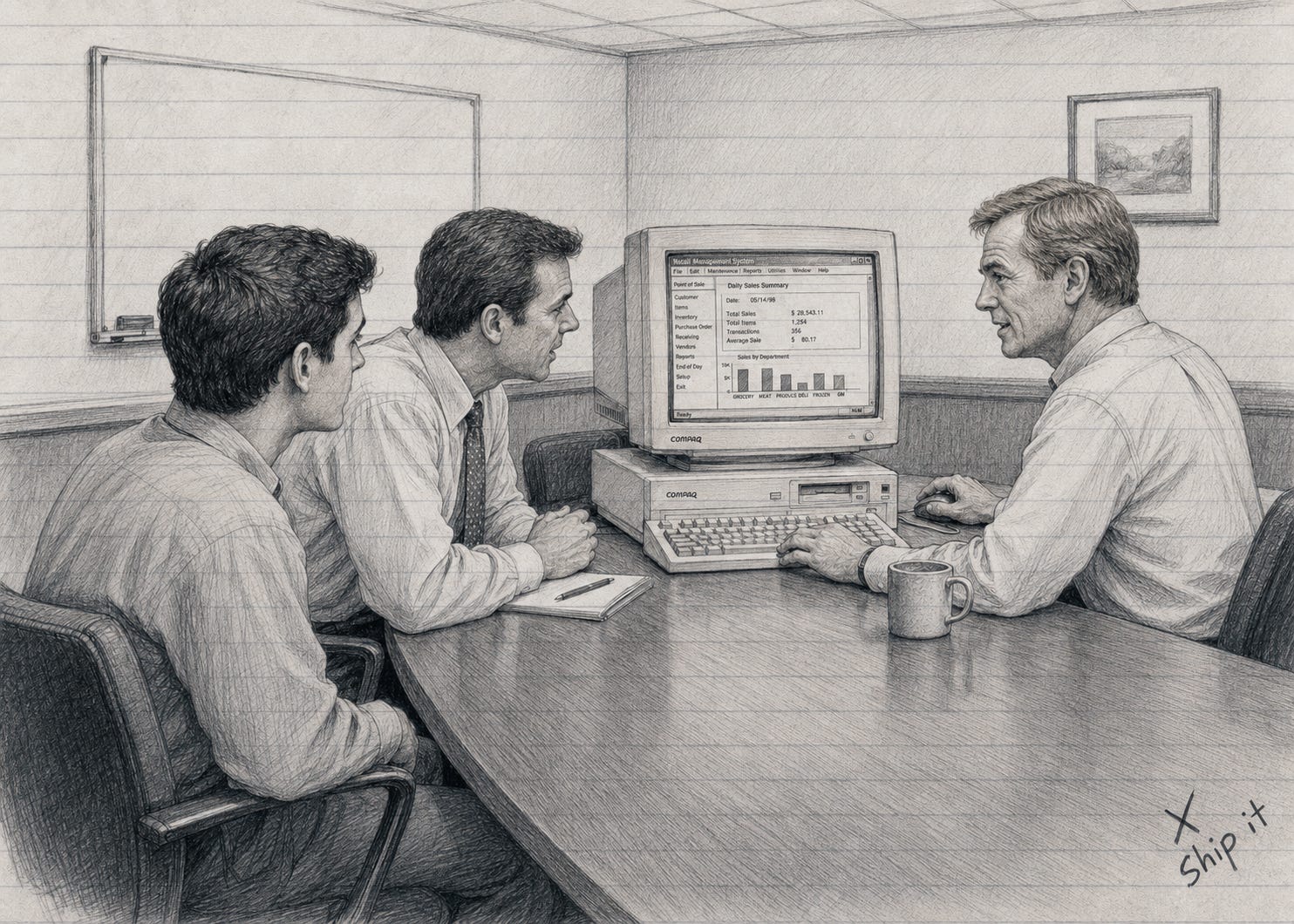
Then Mike would start asking questions.
His favorite move was simple. He’d take a sip of coffee, set the mug down, take the mouse, click the feature himself, and say, “Show me how that works.”
Not theoretical questions. Store questions.
One afternoon he asked, “Show me how to set up a buy-one-get-one promotion across five related items.”
The salesman smiled and reached for the mouse.
Click.
Click.
Click.
More clicking.
A few awkward seconds passed.
Then came the line we’d hear over and over.
“That feature will be available in the next release.”
Mike looked over at me.
We both knew.
Airware.
Software pitched before it existed. Companies looking for a small regional chain willing to be a guinea pig while they worked out the bugs. We were a target. We knew it. Mike spotted it every time.
After particularly bad demos we’d look at each other and say the same thing.
Not ready for prime time.
Same joke. Every time. Neither of us got tired of it.
I didn’t fully appreciate what Mike was doing back then. I thought he was just skeptical by nature. What I understand now is that he wasn’t being difficult. He was filtering. Thirty years of grocery experience meant he’d already seen most of what they were pitching. He knew which problems actually existed and which ones had been invented to justify a product. He knew the difference between a solution and a demo.
I was learning a skill I didn’t have a name for yet.
I’ve seen this movie before.
That’s not closed-mindedness.
That’s experience doing what experience is supposed to do.
Experts don’t know more because they consume more information. They know more because they ignore more information.
What's something you've learned to ignore that made your life better?
The Ones Who Move Fastest
Somewhere along the way, learning stops being about adding.
It starts becoming about editing.
I noticed it sitting around conference tables. I used to walk into every strategy session ready to engage with every idea on the table. Treat each one as a serious contender. Give everything a fair hearing.
Then I started watching what happened to the people who kept doing that past a certain point.
They were exhausted.
Not from the work itself. From the constant reorientation. From treating every new direction as if it had equal weight. From never letting experience do its job and narrow the field before the conversation started.
The people who moved fastest weren’t the ones who considered everything.
They were the ones who had already eliminated most of it before they walked in the room.
I know what you’re thinking. That sounds like someone who stopped being curious.
It isn’t.
It’s someone who got expensive with their attention.
Every yes quietly demands a hundred invisible no’s.
Attention isn’t unlimited.
Neither is time.
Every idea you decide to chase pushes another one aside.
Every commitment costs something else you could have been building.
The Erasing Is the Work
Maybe that’s what wisdom really is.
Not carrying around more information than everyone else.
Carrying around fewer distractions.
I still use that whiteboard almost every day.
I walk up to it with new ideas. Fill sections back in. Draw new arrows.
And then, usually within a few days, I start erasing again.
For a long time, the erasing felt like failure. Like I was proving I didn’t know what I was doing. Like the empty space was evidence of indecision rather than its opposite.
I don’t see it that way anymore.
Here’s what nobody tells you about this process.
The world doesn’t get quieter.
You do.
Fewer ideas on the board.
Fewer directions you’re willing to chase.
Fewer opinions you need to weigh in on.
Fewer arguments worth having.
From the outside it can look like you’re shrinking.
You’re not.
Your judgment is getting better. And better judgment doesn’t need more room. It needs less noise.
The erasing is the work.
It’s the part that takes the most judgment. The most honesty. The willingness to say this isn’t it without needing something better to replace it yet.
Anyone can fill a whiteboard.
What takes real discipline is standing in front of it with an eraser and trusting the blank space more than the noise.
The value won’t come from what survives the marker.
It will come from what doesn’t.
The world isn’t getting simpler.
Every year there are more opinions, more platforms, more experts, more noise competing for the same hours you had last year.
The advantage won’t belong to the person who keeps up with all of it.
It will belong to the person who decided a long time ago what they were going to ignore.
The goal isn’t to know everything. It’s to become harder to distract.
Share this with someone who's earned the right to ignore more.
CTRL Lens
Most people think experience is about what you’ve accumulated.
It isn’t.
It’s about what you’ve stopped carrying.
Information isn’t valuable because there’s more of it. It’s valuable because someone removed everything that didn’t matter.
Anyone can collect information.
That part gets easier every year.
What gets harder is learning to put things down.
The idea that sounded interesting until it didn’t.
The direction that looked promising until you recognized the pattern.
The yes that would have cost you a hundred invisible no’s.
That’s the real skill experience builds.
Not the ability to take more in.
The ability to stop sooner.
You earn that through repetition.
Through being wrong and noticing why.
Through recognizing the same problem with a different name.
Through sitting with the erased parts of the whiteboard and trusting that what’s gone is supposed to be gone.
I trust people who can tell me what they’ve stopped believing.
They’ve paid for those conclusions.
Usually more than once.
The world doesn’t get quieter. You do.
Growth isn’t the full board.
Growth is the clean one.
What are you still chasing that experience has already told you to let go?
CTRL:C
If this was worth your time, three ways to say so.
Share with someone who’s earned the right to ignore more.
What’s one thing experience has taught you to stop carrying?
Inside the CTRL Vault, paid subscribers get the deeper frameworks behind the stories.
Thanks for reading.
~ JP
—
Related:
Experience protects you. Until it starts slowing you down.

The messy middle needs more people in it.
CTRL Signals by JP Bristol
Clarity. Tenacity. Reinvention. Legacy
Hey JP,
I spend most of my client days helping people erase rather than add.
For example, a husband starts a conversation certain he needs a new skill, a better way to argue, a smarter thing to say.
In reality, what he usually needs is to let go of the old identity he's been dragging into every conversation, the version of himself that had to be right, or had to win, or had to prove something that stopped mattering years ago.
I like the whiteboard image and I think it is exactly right.
Growth doesn't look like a fuller board. It looks like a man who finally has the judgment to know what he can put down.
I ask my clients some version of your question all the time, just aimed at a different kind of accumulation.
What are you still carrying that experience has already told you to let go of?
Thanks for writing this and have a great long weekend.
I really loved this. You articulated something that so many people feel but can't quite name: that inherited urgency we absorb from everything that's presented to us by the information environment.
I’ve been hammering on this idea in my own writing: that our ability to curate our own attention is perhaps the most important financial skill we have right now.
It’s comforting to see more of us focusing on this. Your discernment principle is such a clean, practical tool for people to keep in their pocket; it’s exactly the kind of concrete guidance that helps people actually reclaim their own headspace. Great work!