


Last fall, in one of my first essays, I told people to write their obituary.
I never wrote mine.
Gaggy
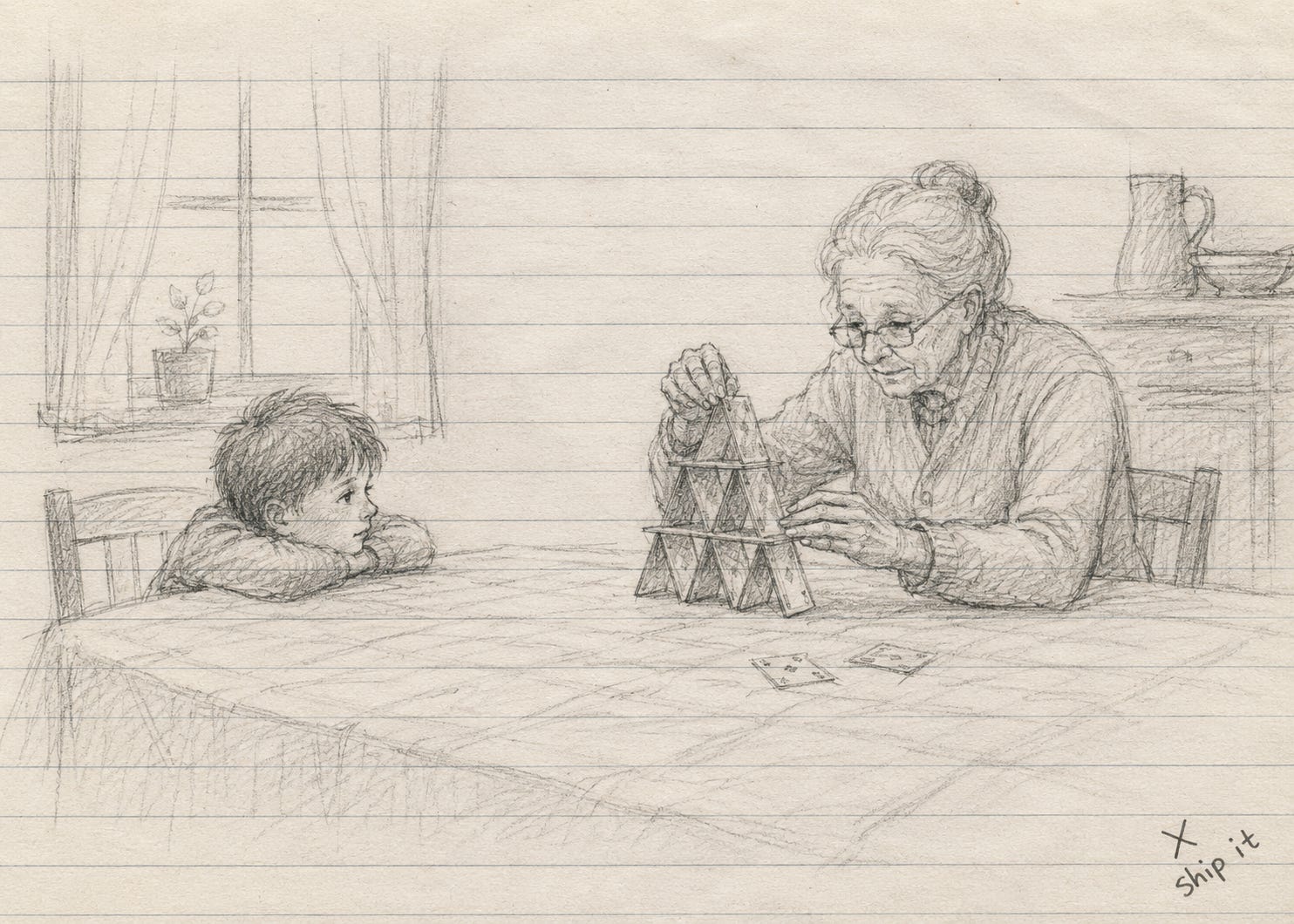
She would pull out the linen cloth first.
That was the signal.
Most people her age did crossword puzzles.
Gaggy built card houses.
Then she would build. One story. Two. Sometimes three. A card house so precise, so patient, that a room full of people would go quiet just watching her hands move.
Four foot ten. Sweet as she could be. Her name was one of my first words. They were trying to teach me great-grandma. What came out was Gaggy. It stuck.
She pushed my stroller on long walks before I could walk beside her. Taught me Go Fish. Lived with my grandparents into her eighties.
She became part of the architecture of who I am.
The Wandering
When the dementia came she changed. Childlike. Sometimes feisty.
Got up before dawn and walked. Wasn’t supposed to. Didn’t stop her. My grandmother would get a call from a neighbor.
Your mom is headed toward the highway.
Sometimes it was the police who found her first.
One time at the beach she just started walking before anyone noticed she was gone. My mom went after her. Stopped strangers on the sand.
Have you seen this woman?
Oh yes, she went by here five minutes ago.
Eight minutes.
Fifteen.
She was at the end of the road when my mom finally caught up with her.
She had walked for miles by then.
The beach was gated. That’s what finally stopped her.
She went to a nursing home eventually. My grandmother took me on weekends to visit.
There was a smell there.
I was very young.
But I knew what it meant.
I don’t like hospitals today. I never have. Sometimes I walk in and catch it. That smell.
And I’m six years old again standing in that hallway.
The Goodbye Problem
I didn’t get to go to her funeral. My grandmother didn’t think funerals were for children.
She thought she was protecting us.
It didn’t protect us from the loss.
It just meant we never learned how to face it.
I’m not even sure if I found out she was gone before or after they buried her.
I never got to say goodbye.
And I haven’t known how to since.
The grandmother who kept us from funerals spent her last days in hospice.
I was there.
It didn’t get easier.
My father’s side of the family handled death differently.
Before my grandmother died, she wrote her own obituary and recorded herself reading it out loud so it could be played at her funeral.
I can still hear her voice.
Calm. Matter-of-fact. Almost practical.
Hearing my grandmother’s voice at her own funeral made me deeply uncomfortable.
And gave me a sense of finality at the exact same time.
She made herself part of the service.
My mother’s side tried to protect us from death.
My father’s side looked directly at it.
Somewhere in the middle, I learned how to avoid it entirely.
The Steel Man
My great grandfather on my grandfather’s side was a quiet, hard man.
Six foot three. Slender. The kind of man who fills a doorframe without trying.
Where Gaggy was four foot ten and sweet as she could be, he was the other end of the spectrum entirely. Same generation. Different world.
He would visit my grandparents and I got to spend time with him that way. Standoffish is the word I’d use. Not cold. Just contained. I’m sure he loved everyone in that house. I just never heard him say it. Not to me. Not even to my grandfather.
The noise from the children playing would get to him. You could see it. My grandmother would pick up on it before it became anything and shoo us into another room without a word.
He was an early riser. So was my grandfather. So am I.
I would run into him in the kitchen in the early morning. Black coffee. Half a grapefruit in a bowl. The same jagged-edged grapefruit spoon every morning. Oatmeal. The National Geographic open on the table.
He’d look up.
Good morning.
That was it.
Man of few words doesn’t cover it.
He spent his career selling the steel that built American cities. Buildings. Bridges. Skylines you can still point to today.
Structures that will outlast everyone who ever sat in that kitchen.
I only know because other people told me.
He never talked about it himself.
I didn’t get to go to his funeral either.
The Friends I Couldn’t Reach
The first kid I met when my family moved into the neighborhood was six years old. So was I.
He introduced me to everyone. We were inseparable for years.
We smoked our first cigarette together. I picked up the habit. He didn’t. We tried whiskey for the first time. Bought and listened to our first punk album. Planned and threw our first rager party.
A lot of history. A lot of firsts.
Eleventh grade his mom died. Lung cancer. He started to withdraw. By senior year he had dropped out. We lost touch for years.
Then we’d run into each other again. A party. A get together. A familiar face in an unfamiliar room. We picked up easily enough when it happened. That’s how it is with a guy you grew up with.
A few years ago I got a call from a mutual friend.
Pancreatic cancer. Stage four.
I couldn’t make myself go see him.
And then he was gone.
I didn’t go to the funeral.
Another friend I met at sixteen. Life scattered us. He moved to California. I got married. Years passed. Then in 2009 my wife and I went to San Francisco and he showed us the city. Took us to dinner. To some clubs to see live bands. Introduced us to craft beer.
The whole week felt like no time had passed at all.
That same mutual friend called again.
Melanoma. Brain metastases. He’s not doing well.
Within days he was gone.
He had moved in with family after he could no longer work. He was a thousand miles away in Florida.
I told myself that’s why I didn’t go.
That’s not why.
What I Didn’t Know I Was Writing
Last Saturday I published a piece about the Colosseum.
About what survives. About stone that outlasts the empire that built it.
I didn’t know I was writing about any of this.
Gaggy building card houses on a linen cloth. Precise. Patient. Gone before I could say goodbye.
A man who sold the steel that built American cities. Skylines still standing. Gone before I could say goodbye.
Two friends who knew me before I knew myself. Gone before I could say goodbye.
I’ve been writing about permanence and loss my whole life without knowing it.
The Colosseum piece was just the most recent draft.
As I started writing this one I realized I had already started it last week.
I just didn’t know what I was actually writing about yet.
What My Wife Sees
She calls me a turtle. Hard shell. Soft inside.
In private she’s also called me the tin man. She says, Not because I don’t have a heart. Because I don’t know how to show it.
When someone dies I never know what to say. I’m terrified of getting it wrong. So I say sorry for your loss and hope it’s enough and know it isn’t.
I have helped write obituaries. My dad’s. My grandmother’s. You sit there with a blank page and a grief that has no bottom and you try to compress a whole life into something that fits in a funeral program.
I know how to write them for other people.
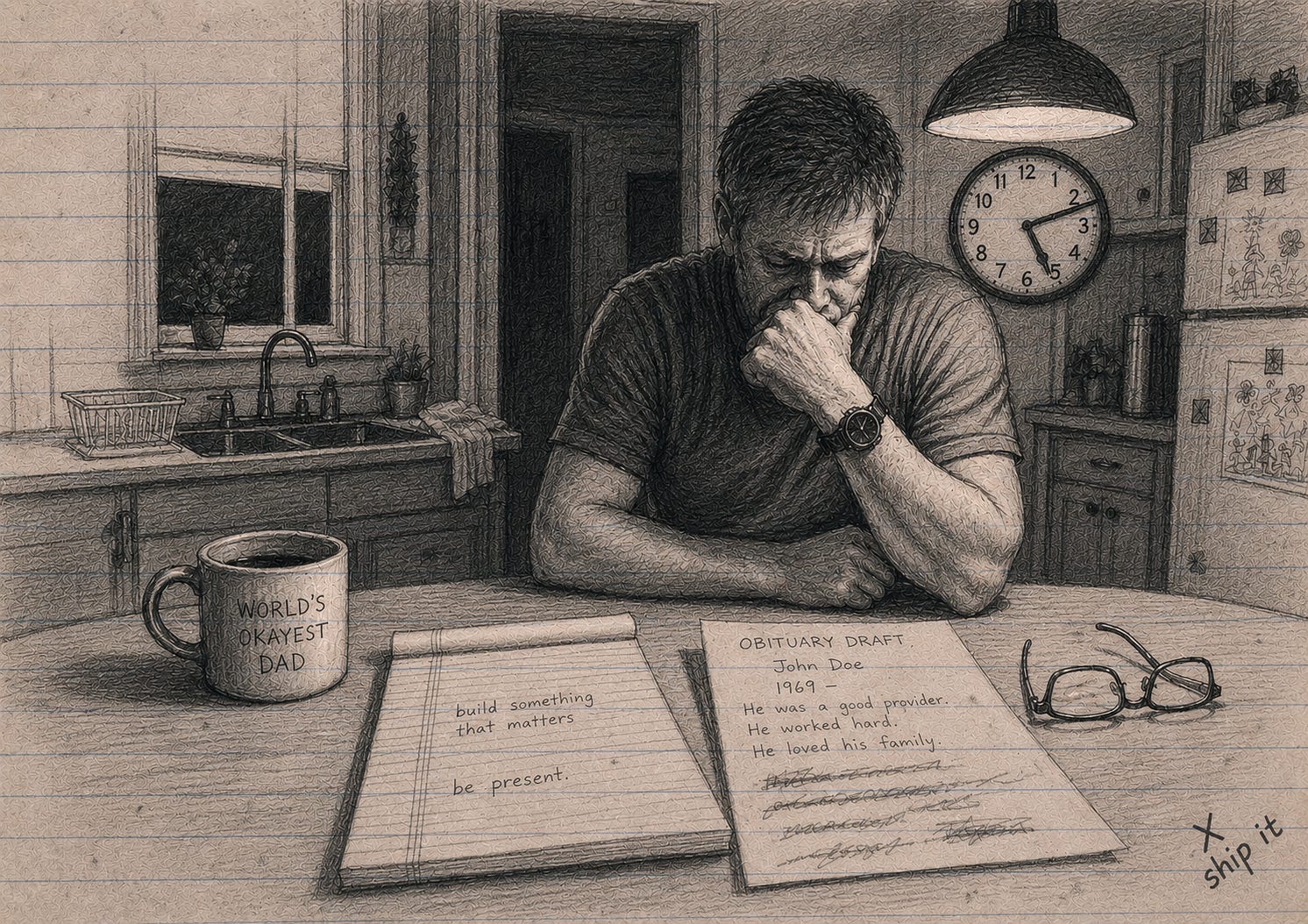
I’ve never been able to write my own.
The Two Drafts
Last summer:
He provided. He protected. He made sure everyone would be all right. He kept a healthy paranoia that he was one step from losing everything and let that drive him. His family never went without. That was the mission and he executed it every single day.
That’s not a small life.
But it’s a life built entirely around what he kept safe.
Not what he built. Not who he helped. Not what survived him.
Today:
He decided the provider wasn’t the whole story. He took thirty years of hard-won knowledge and stopped hoarding it. He built something before the sun came up and after everyone went to sleep. He wanted to help people get unstuck the way nobody helped him get unstuck. He didn’t wait until he had it figured out.
He started while he was still figuring it out.
The distance between those two drafts.
That’s what eight months looks like.
The CTRL Lens
I didn’t avoid this exercise because it felt morbid.
I avoided it because I already knew what it would say.
The trajectory you are on right now is writing your obituary.
Not someday. Today.
Every decision. Every postponement. Every thing you keep calling someday.
Last week I wrote about the Colosseum.
About what survives.
I thought I was writing about ancient stone.
I wasn’t.
I was writing about Gaggy pulling out a linen cloth to build card houses that would eventually collapse anyway.
About a quiet man who helped build cities that will outlast him by centuries.
About friends who disappeared before I figured out how to say goodbye.
About the difference between protecting a life and building one.
Gaggy pulled out the linen cloth because the work was worth doing.
The card house was going to fall eventually.
She built it anyway.
The linen cloth is still on the table.
She always pulled it out.
CTRL: L
If this was worth your time, three ways to say so.
Forward this to someone who's still avoiding the question.
Tell me about someone you never got to say goodbye to.
Wednesday in the Vault, we go deeper on the one exercise most people avoid not because it’s morbid but because they already know what it will say.
What your obituary would read today.
What would have to change for it to read differently.
And the diagnostic for closing that gap before it closes itself.
The Obituary Audit.
That is what we are opening up next.
Thanks for reading.
~ JP
—
Related:
Why we question self-investment harder than almost anything else.

CTRL Signals by JP Bristol
Clarity. Tenacity. Reinvention. Legacy
We never know how much more time we have left. But I'm more recently aware that I both want to do more for myself and leave more for my family. Thank you for this post, JP!
This is so profound. Reading about how uncomfortable it is to write about the end while we’re still in the middle of something.
This one will stay with for a while.